Bon Appétit, My Brain

Bon Appétit, My Brain
Recently, I looked in the mirror while brushing my teeth and thought about how I’ve aged in the past five years. The rivers formed over the years by my deep smile and eye wrinkles now have tributaries. Babies, I thought, then sighed.
Later, when hiking with a friend, we talked about how not only our faces but our once perky breasts are in a major slump. A long, reflective sigh followed.
Drenched with sweat on a hike that would have barely made us glisten five years ago, we compared the fat folds on the bottom of our upper arms, pinching the skin and shaking it back and forth for emphasis. Mine were noticeably flabbier than hers. Sigh.
But when she complained about her wizened posterior and how the skin puckers like ripples going down her leg, I replied that my butt has gained in strength and size, like a lava dome, thanks to my years of leading workout classes, up to six a day, in which we did squats and in which my glutes, both maximus and minimus, were stimulated—overstimulated.
But she’d been taking my classes for sixteen years, faithfully doing her dead lifts, bridges, lunges, and squats, so why had her butt betrayed her? I explained there was a difference of about seventy pounds between us, with her having less than the average amount and me having enough for both of us. Carrying extra body fat as we age isn’t helpful! Heavy sigh.
Our bodies tell us more about what we eat than how much we move. I’m a certifiable stress eater and nowadays am stressing about my family, the community, the world, and the Earth—and my body shows it (as well as my face!).
So these days I’m focused on the “Food is medicine” theory, which simply means eating only whole, unprocessed, healthy foods. There’s nothing I want to do about my pruney-looking face besides my not-so-magic face cream. I’ve never used sunscreen, nor will I (I think it’s only days till they announce that it, too, causes cancer), and no way, nohow am I staying out of the sun. I won’t be spending my hard-earned money on a red-light face mask, chemical peels, Botox, or surgery—although I would love to have the kind that corrects droopy eyelids, if my insurance would pay for it. My mom had it and gushed about how much she could see afterwards: “Janie, there was a whole half of the world I’d been missing!”
Instead, with my new-found commitment to using food as my medicine, my focus has shifted to things like blueberries, salmon, broccoli, avocados, and green tea—but no dark chocolate. Dark chocolate is chock-full of antioxidants, but when self-regulation is your weakest character trait, you don’t mess around with having dark chocolate in the house. Triple sigh.
Food is medicine not only for our bodies but for our brains too. And since both my sister and brother developed Alzheimer's at an early age, this is also something I want to pay attention to.
Focusing on food as medicine includes turning my back on flour and sugar, which are known to cause a dopamine release that leaves you craving more and can make you more susceptible to an eating disorder. More importantly for me, too much sugar can lead to cognitive decline, memory issues, and even the risk of Alzheimer’s, exactly what I’m trying to avoid. Bottom line, I’d rather remember who Dane and Jessica are while sporting a face full of rivers and tributaries and a significant, dare I say powerful rump.
And while I can still remember things, I want to share with you my memory-enhancing recipe that I call my million-dollar, super brain, protein-filled, anti-inflammatory breakfast.
In a small pan, mix 1/3 cup steel-cut oats with 2 level teaspoons each of poppy, hemp, and chia seeds. Stir in 4 teaspoons of collagen powder, 1/2 teaspoon of lion’s mane mushroom powder, one scoop of creatine powder, and a generous amount of cinnamon. Now add water: I start with a half cup and then, as it heats up on the stove, I add in more as needed. Keep stirring it over low heat—do not wander away to answer the phone, scroll on social media, or pick up your favorite book with only one chapter left. Keep your eyes on the pot and don’t let it boil or let the bottom burn. When the oats are cooked, add a heaping teaspoon of coconut oil, six ounces of blueberries and, when it’s all smooth and toasty warm, toss in a generous handful of walnuts.
Bon appétit, my body and brain!
Hoping for the Best

Monkey as a kitty
Hoping for the Best
Monkey, my black “winter cat,” recently spent a week in the closet—and we spent the week trying to figure out why.
We picked Monkey out at the Driftless Human Society nine winters ago. What sets him apart, besides his sweet personality, are his fangs. His fangs overlap his bottom lip, giving him a slightly vampirish appearance, but fortunately, this causes him no problems.
Monkey likes to sit on the counter and watch me with his big, round, green eyes. He’d rather wait to be petted than rush over with the rest of the gang to eat kibble.
Almost two weeks ago, I heard hissing and was surprised to find out it was Monkey. When I bent down to see why he was hissing, I noticed he was dragging his back legs. The field vet was coming out the following day for Vincent Van Goat, who wouldn’t put his back leg down, so we got Monkey settled and waited.
By morning Monkey had moved to a box in my closet and was still there when the vet came to check him out. Thankfully, she said his back legs were fine, no breaks (nor was Vincent’s leg broken). She chalked it up to tomfoolery and gave Monkey prednisone to reduce inflammation.
But Monkey didn’t get better. I hand-fed him, dribbled water in his mouth, and carried him to the litter box, where nothing happened. He didn’t pee or poo, and he dragged his lower half around.
Four days after starting prednisone, with no improvement, I took him to our dog and cat vet in Viroqua. They did x-rays and confirmed that nothing was broken. After examining him, they decided he might have suffered a neurological injury and a possible infection, so they sent me home with antibiotics.
Monkey still meowed to be petted but he stayed in the closet. He would drag himself to the litter box but had no success, so back to the vet we went. His bladder was the size of a small water balloon. The vet showed me how to release it, but there was nothing we could do about his nonfunctioning bowels. With more tests and research it was decided that he had pulled-tail syndrome. But who would pull dear Monkey’s tail?
Pulled-tail syndrome is serious. It affects the nerves in the lower tail and spine and often causes difficulty in a cat being able to go to the bathroom. Back home we went, with instructions on how to help Monkey with his bladder and how to take his legs through a full range of motion a few times a day.
We were still perplexed about how his tail could have been pulled. Mentally I blamed the UPS man whose drives too fast on our road, the mail person who recently missed my driveway and drove into my front yard, my two bigger dogs that like to roughhouse, and Leo, my youngest cat who plays too hard.
Recently I found a picture of Monkey when he was little. His tail is so long it goes out of the photo and comes back in! Could Monkey’s long tail be part of the problem?
The x-rays and exams showed no damage to his tail and no teeth marks or wounds. It’s a good thing I kept the blame to myself. According to the vet, a cat can get its tail caught in any number of things, then pull to get it out. Who knew?
What I do know is that my heart aches for Monkey. He doesn’t seem to be in pain except when he tries to use the litter box. We were feeding him by hand and getting water in him by mixing canned food with water, but then he stopped eating. And I was having a heck of a time releasing his bladder.
Now he’s been at the vet’s for the past five days, where they can give him fluids intravenously and help him more effectively with his bathroom hygiene. He’s also had a few acupuncture treatments.
The house isn’t the same without Monkey. I miss seeing him on the counter, waiting to be petted, his eyes following my every move.
Tomorrow we’ll pick him up from the vet. I’m guessing he’ll head straight for the closet again, where he feels the safest. We can only hope for the best.

Monkey as a teen
Father’s Day

Father’s Day
Lorca, my largest cat, is the first one I greet: “Happy Father’s Day,” I say, as I get him his bowl of kibble. He’ll only eat on top of Dane's desk. Lorca doesn’t like to eat with the other cats.
The rest of the crew are all in their typical places. Monkey is watching my every move from the kitchen counter. He doesn’t go right for his food bowl; he wants to be petted and adored first. Rupert does too, so he heads for the bathroom, where he knows I’ll eventually go, and where he’ll hold me hostage as I rub his ears. Food doesn’t have as much appeal for him as affection.
As I’m about to wish Leo, the youngest feline, a happy Father’s Day, I’m already cycling through memories of my dad, whom I called Popsie Turtle. Because it’s morning, I picture him sitting at the kitchen table, a stocking cap perched on his wide head. He’d be holding the newspaper with one hand while the other rested on the handle of his cup of black coffee.
Dad was the first to awaken each morning. When I was younger, I’d get up early and tag along behind him as he fed Kelly and Albert, our dogs, raised the flag that he'd taken down the evening before, and often swept the garage and then hosed it down.
My dad was a good dad. On summer afternoons, he’d ride his bike up the path through Hales Corners Park to the swimming pool, where he’d lean it against the chain-link fence of the diving well section. Still seated on his bike with his fingers in the fence so he wouldn’t tip over, he’d call out encouragement to me as I made my way up the ladder. I’d stand on the tip of the high dive board, bent over, with my hands over my head and my fingers pressed together. My nose plugs were a constant source of amusement for the other children, but I hated getting water up my nose as I tipped over and plunged into the pool.
When I surfaced, I’d walk over to the fence, leaving a trail of water on the hot concrete, and Dad would give me a score between 1 and 10 with instructions on how to improve my dive. I never did get a 10, although my persistence paid off on the low diving board, where I was more comfortable.
In winter, Dad would tie his worn hockey skates and my figure skates together and drape them around his neck, and we’d walk that same path up to the ice skating rink. He never seemed to get tired of playing with me in all seasons.
Having fed the cats, I go outside to do chores—and that’s when it occurs to me that not only Lorca but the other male cats, as well as the male dogs, Finnegan and Ruben, and the donkeys and goats, will never be fathers.
I promptly change my greeting; “Happy You’ll-Never-Be-a-Father Day,” I say to Diego and Carlos as I toss them their hay; “Happy You’ll-Never-Be-a-Father Day” to Hans and Vincent, as I feed them banana slices.
There’s nothing wrong with making the decision not to become a father. At my place, I made that decision for my critters. But human males can also make that choice—and wouldn’t that solve a lot of problems, I think.
Back inside the house, Monkey is still waiting for more love. While the water for my coffee is heating, I scratch him under the chin and silently thank Popsie Turtle for having been a good dad. I got lucky.
Happy Father’s Day, Popsie Turtle. I hope you’re enjoying an ice-cold Pabst, Camel straight, and a hot game of poker, wherever you are.

A Year of Grieving

An angel statue honoring Helena on Jane’s deck.
A Year of Grieving
It wasn’t until this hose season that I figured out what had been going on last summer.
A few times a day, I drag the hose from the back of my house around the property, a never-ending task of keeping the critters’ bowls rinsed and filled with fresh water. Last year, anyone passing by would have heard me cursing as I yanked and wrestled with a hose that kept kinking before and after every watering stop in my routine.
As August came and went, I was still swearing at the hose, struggling through chores, and my body felt tied up in a constricting knot. By the end of September, I was completely wiped out.
This year, as I calmly move the hose from place to place, I understand: last year I was angry—furious.
Grief does that. I didn’t understand at the time how angry I was as I lashed out at the hose, or how my sorrow after my granddaughter Helena’s sudden death had leached away all my energy.
From the moment I’d picked up the phone and heard my son-in-law Brad say, “Helena has been killed in an accident,” the world as I’d known it had stopped.
Anxiety took over, leaving no room for me to breathe or think straight. Worry about my daughter, Jessica, became a full-time job. Had she gotten out of bed? Was she able to get through her work day? If the phone rang, my heart sped up and my mind raced: Was someone hurt? Did someone else die?
Depression weighed me down. I’d sit slumped on the back porch, unable to move. The Duck Hall needed cleaning, the grass in the goat pen was knee-high, and Louisa’s pool needed to be scrubbed, but I couldn’t move. I just couldn’t make my limbs function.
The anger and weariness that grief brought were beyond any I’d known before. I was so angry I’d stomp through my chores. I was too tired to cook—my body couldn’t stand long enough to wash, cut, or dice. By November, I could barely walk. I felt my body was betraying me, like the universe had betrayed my grandchild. Only my work of teaching fitness classes kept me moving.
Grief manifests differently for everyone, and this is how it has looked in my life—how the unexpected death of a loved one shook up my sense of reality. Anything could happen at any time.
Alongside the heartbreak of never seeing my granddaughter grow into the caring and compassionate adult she was becoming was my crushing concern for my daughter.
Are you up? I’d text Jessica each morning. One-word answers came back: Yes. Up. The same held true for nighttime. With my child in so much pain, my heart slogged instead of beating. Our morning and nightly messages were the new normal, a way for me to keep the pulse of her health, her grief.
My worry about my family, wondering what next? and who next? continued through fall, winter, and back into spring, because the ever-present fact is that everyone will die, and there is no magic age. Children die from cancer, teens like my high school friend DJ die suddenly from bad hearts, and young people get killed in car accidents.
It’s June again. I meet Jessica in Madison to select a statue for a memorial she’s creating for Helena. As we search for the perfect statue, Jessica spies a green blanket with daisies and says, “I think of Helena...” as she touches the blanket.
“Yes, you always picked out a blanket for her when we went out together.”
We keep walking, each of us knowing the other is crying.
Over lunch at an Indian restaurant, I ask Jessica if she’s made plans for Helena’s death day. We discuss grief, guilt, and life after death. As we sit, tears filling our eyes, the waitress comes by and asks, “Food too hot?” Jessica shakes her head while dabbing her eyes with her napkin.
When the concerned waitress comes a few minutes later and asks again, Jessica manages to look at her and murmur, “Emotional,” and then excuses herself to go to the restroom.
After lunch, we say goodbye. Later, I find her message: I’m home, are you?
Yes, I am now.
This is how a year of grieving looks in my life; the anger, depression, and overwhelming fatigue are real. The sadness of knowing Helena isn’t coming back is real. And the fear every time I hear the phone ring is real, because who really knows? Anything can happen at any time, and life will never be the same.

Everything Changed

Helena tiring on one of her outfits the night before her brother’s wedding.
Everything Changed
One day, one phone call, and everything changed.
Just days before, I’d been counting my blessings, thinking about my family. Everyone was doing well. My grandson Ethan had just married Natalie, and his sister Helena had enjoyed participating in the events. Earlier, my daughter, Jessica, and her husband, Brad, had taken a trip to their favorite place in South Carolina. And my partner, Dane, was exceeding expectations in his heart recovery.
Life was good—and then the phone rang.
“Helena was killed in a car accident.”
“Oh God. Oh, my God! I’m on my way.”
Time slowed down as I rushed around the house, trying to think of everything I had to do. I needed to call Dane, cancel classes, feed the animals, get in the car. Mostly I needed to be with my daughter, right this minute, but it would take a three-hour drive to get there.
Nothing made sense. Just a week ago all of us had been laughing as Helena balanced her brother’s wedding cake on her lap while her dad maneuvered the expressway to get us to his son’s wedding on time.
Words came out garbled as I spoke to family members on the phone, trying to piece together what had happened while Dane drove. The car couldn’t go fast enough. The family would be there, so Jessica wasn’t alone, but the slowness, the unknown, was painful.
Two weeks ago Helena was trying on outfits for Ethan’s wedding. She was eating dinner with us the evening before the wedding. She slept in her brother's room that night, giving us her bedroom, saying, “It’ll be the last time Ethan sleeps here.”
She sat next to her mom and Dane in the first pew at the wedding. She laughed at my jokes. She looked beautiful, and happy to be there. She clapped when the minister announced Mr. and Mrs. Christensen.
Afterwards Helena was called up to the altar for photos: Her and Ethan. Snap. Her, Natalie, and Ethan. Snap. Helena with Ethan, Jessica, and Brad. Snap. Dane, me, Jessica, Brad, Ethan, Natalie, and Helena. Snap. Snap.
It must be a mistake—she can’t be gone. But when we finally make it to Brad and Jessica’s home, the sound of my daughter’s anguished cries makes it real.
Jessica wants Helena to have “her blanket.” Climbing onto the bed, I spoon with Jessica while Brad lies in front of her.
Today, a year later, here is what I know.
There is no comforting a mother who has lost her child. There is only being present. There is only listening, and reminding her to take her medication (which brings only temporary yet much-needed relief).
You can wash the dishes, make a healthy breakfast, fold the bedding you used for sleeping on the couch, sort through thousands of photos, and simply hold your daughter's hand when it’s all too much.
You can field phone calls and run interference when someone brings flowers to the door because she doesn’t want to see or talk to anyone.
But there isn’t anything a grandmother can do to change things, despite being willing to do anything for your daughter.
And that hurts. A primal, gut-wrenching tearing is close to the surface, but you can’t give it any oxygen because you need to keep your focus on the mother who lost her precious child.
We bear witness to emotions we’d never have wished to see or hear. A group family hug with tearful words: “We need to stick together now more than ever.” Zoom calls with the doctor: “Is there something that can help with sleep?” A conference between husband and wife while the organ donor folks are on hold, then agreeing and telling them, “Take, use whatever you can.”
For Brad, there’s a trip to the morgue, police calls, funeral home calls, legal calls, a hospital visit, and work calls. For Jessica, there is a void so raw and painful that speaking is difficult. But for a grandmother, there is no time for grieving until after dark when the house is quiet.
Then you lie on the couch, with Preens, the cat that only liked Helena, and wait. You’re waiting to be there if your daughter gets up during the night and needs you. You are praying that your daughter and her husband can get some sleep. You are not even close to comprehending that you’ll never see your granddaughter again. That she won’t be going on the backpacking trip that you’d dreamed of taking her on someday.
She won’t get that chance. And you’ll never get to see her grow older, grow better—but you know she would have.
After all, she had just spent a joyful weekend with her family, the weekend of her brother’s wedding, and she was utterly happy—until everything changed.

The outfit Helena choose for the wedding.
Flying High

Flying High
As soon as it’s light enough to see, I run outside in my PJs and remove the rock that’s covering the opening that's waiting to receive my new flagpole. The concrete surrounding it seems hardened and ready. Now I just need to contain my growing excitement until Dane finishes work. Yesterday I got part of my birthday wish of installing the flagpole, but today is the day my flags will fly for the first time!
After I finish teaching a morning exercise class, I run back out and search for my turtle, Maude. Seeing her emerge from her winter brumation was a birthday wish that didn’t come true this year. Her pen is overgrown, and as I call her name and talk to her, willing her to come out, I pull thistles and other weeds and toss them over the fence.
Eventually I tire and notice that my ankles are burning. I’m not wearing socks, and the nettles are stinging me. I go inside and sit on the edge of the tub, where I run ice-cold water over both feet to lessen the sting. Then I get busy. I have a full day of work projects and one meeting that will make the time fly until Dane gets here.
Soon enough, I hear tires on the gravel driveway, and I run out to greet Dane and tell him the concrete is hard. All systems are go for raising the flagpole!
The pole I bought is twenty feet long, consisting of five four-foot sections. I help Dane fit the sections securely together and lay the completed pole beside the hole.
Our plan is that on the count of three, we’ll lift the pole and maneuver the bottom end into the hole, and up she’ll go. I bend my knees, reminding Dane to use his knees and not his back.
One, two, three—and nothing. It’s heavy and awkward. We try again, this time lifting the pole off the ground, only to set it back down when we realize Dane needs to be positioned at the bottom to guide it into the hole. Finally, up, up, up the pole goes! My excitement overflows and I start clapping and jumping around.
We both stand at the bottom and look skyward. Holy cow, we can barely see the top. No one driving by would even notice the flags unless they stopped, got out of the car, and craned their heads skyward! Laughing, we quickly decide to take the pole down again and remove a four-foot section. Sixteen feet seems perfect.
Dane starts attaching the flags, placing the American flag at the top. This takes a bit of work and patience because I’m all in a tizzy about not letting the flag touch the ground. My dad was in the service, and he made sure to teach us kids about flag etiquette: Never let it touch the ground. Always bring it in before dark or keep it illuminated. Be respectful of the flag at all times.
Next we add the Pride flag. I’m adamant that people know they are welcomed here as a fellow human. Last but not least we add an Earth flag.
By evening, the flags are flying high, the bats have emerged from their secret spot near the chimney and are checking it out, the cats are sniffing around the base of the pole, and soon it will be dark. “Dane!” I cry, “We need to take them down—it’s going to be dark soon.”
Dane shakes his head in disbelief. “Are you seriously going to put this up and take it down daily? No one does that anymore.”
In my mind, I run through the many flags I’ve seen flying in peoples' yards. He’s right, I don’t believe they take them in and out each day—they’re always up. I worry that Dad is going to roll over in his grave, but I vow to add a solar light.
For a while we lean against the car and watch the bats and the flags fly. Then, after scolding the cats for trying to use the dug-up dirt around the flagpole base as their new litter box, we head inside.
After dinner, we both fall into bed, happy to have the pole up and the flags flying. In the morning, I’ll look first at the flags to see if there’s any wind, and then I’ll search again for Maude. I can’t wait to show her the flagpole.
Birthday Wish

Birthday Wish
It’s my birthday, and I’ve been up since 4 a.m., trying to be patient until Dane wakes up. I have a birthday wish!
Finally, I hear him moving around. I’m so excited for the day, I could self-combust. Instead, I hide behind a closet curtain, standing as still as I can until Dane comes down the stairs and walks past. I reach out and grab him, saying, “Hello!”
He screams and pulls away. “You do know I have a heart condition?!”
“I’m just making sure it’s working properly!”
After a quick morning hug and before Dane has even had his coffee, I’m rattling off birthday plans, which include taking the pups for an early walk. I’m taking advantage of my birthday, knowing I can only get away with this on special occasions.
People often ask why we don’t live together, and this is a good example. I love hitting mornings full on, with conversation, a cup of decaf, and getting the dogs out on an early hike. Dane loves mornings too, but prefers to ease into them with an established routine: caffeinated coffee, reading, scrolling, breakfast (either oatmeal and an orange at my house or one egg, toast, and an orange at his), followed by a shower, clean clothes, and quiet. I often complain, “Daylight’s burning,” at 4:30 a.m. in the summer and 6 in winter. Breakfast? No time! Shower? A little dirt never hurt anyone. Clean clothes? Why, when I can keep my PJs on?
But today is my birthday, and I know Dane will make an exception for me. As he gets his coffee, I tell him my big wish: “I want to put up the flagpole!” We both know what this means: Dane will measure the area, dig the hole, double-check everything, and pour the cement, while I oversee. I’ve even found an instructional video for him!
I’m most excited about the waterless concrete because I know Dane doesn’t like messiness. “We’ll pour the dry concrete in the hole and sprinkle water on top. The earth does the rest,” I parrot from watching the video.
I continue shadowing Dane as he makes breakfast, sharing my family’s flagpole stories, which he’s heard before. They’re one of the reasons I’ve bought myself a flagpole—I’ve always wanted one.
Dad, like Dane, was particular and precise about home projects. The erection of the Schmidt flagpole was no exception. While Mom, Jill, and Jack slept. I joined Dad in my PJs and watched him sip coffee as he measured, dug, used string to mark off a square, and yelled at Fat Albert, our dalmatian, for lifting his leg on our project.
By the time the rest of the family woke, I was pestering them to come outside. Dad was already mixing the cement in an old wheelbarrow and was ready to pour. We kids got to press one hand in the wet cement at each corner of the concrete square that would hold up the pole. Then Dad used a stick to meticulously carve our names there for eternity.
Raising the long, heavy flagpole was an ordeal, with a lot of directions, some cussing, and too much tomfoolery for Dad’s liking. But then, there it was: the flag flying high and proud in our yard.
Now the dogs have been walked, we’ve been to Nelson’s and back, and Dane has dug a perfect hole, without running into any rocks. On hands and knees, he’s used the level and made adjustments, and now it’s time for the concrete. I’m still amazed that it’s as easy as pouring powder into the hole—but we’ve come up short. It’s a Sunday, and we race back to Nelson’s and buy another bag of cement minutes before they close.
I’m disappointed when Dane places a rock over the opening for the pole, saying, “Now it needs to dry until tomorrow night.” What? I thought it would be a one-day project.
As Dane heads home, I look for Maude the turtle. She’s been brumating all winter (turtles’ version of hibernating) and I hoped she’d come up for my birthday, but she seems to have other plans.
When Dane calls to say goodnight, I assure him this was one of my best birthdays ever. I’ve loved watching and helping him prepare the flagpole space. He made my wish come true! I go to bed thankful that both of us love a good project—and that he does most of the hard work. I hope tomorrow we’ll see Maude!
Dump Day!

Dump Day
The back end of my Kia was nearly scraping the pavement as we drove up Elk Run Road on our way to the dump. The trunk and back seat were stuffed with four-foot metal posts, assorted wire remnants, a variety of handheld weights, books, four large area rugs, and other whatnots, along with our garbage and recyclables.
After Dane backed into a spot in front of the garbage receptacle, I hopped out and, with two hands, flung the garbage bag. It landed with a satisfying thud at the bottom of the bin. This meant we were early. Another hour and I would have had to swing the bag on top of a mound the size of Mount Everest, then hope it would stay and not cause a landslide.
I was about to grab the recyclables when I heard, “Jane!”
It was my neighbor, Ann, whom I didn’t recognize because her hair had grown so long! I hadn’t seen her for months, since before she and her husband, John, left to spend the winter in a warmer location. Although she attends my online exercise classes, her computer camera and sound had been malfunctioning all winter. It was good to see her.
As Ann told me about her and her husband being ill twice with a norovirus, I looked more closely as I listened. She’d had a rough winter. It didn’t seem fair, as she’s a giving and caring person. When Dane was recovering from his heart attacks, Ann and John would grab our garbage on dump day, and Ann would drop off homemade soups, all low-sodium, just like the doctor ordered.
Now Ann looked tired, and it appeared she had lost weight. Yet she also looked pretty and serene.
As Dane huffed and puffed, carrying our giveaways to the free table, Ann explained that John had been diagnosed with leukemia. The doctor had predicted, “Five years.” John had also become blind in his left eye from macular degeneration.
“That’s too much. Too much,” I said. But then Ann smiled and said that when John finished mowing the lawn for the first time this year, he came indoors and said, “That was fun!” Ann shrugged her shoulders and gestured “Who knows?” with her palms.
What I know from experience is that they’ll need more than good thoughts and prayers. They’ll likely need practical help with everyday chores.
When Ann left, I helped Dane place the metal posts in front of the metals container, hoping someone would be able to use them. We both checked the free table as we added our rugs to it, but didn’t see anything we needed.
As I opened the car door to get back in, I saw a man carrying several birdfeeders—a green suet cage, a finch food holder, a large white feeder for sunflower seeds, and a wooden house that would hold both suet and seeds. “Hold on,” I said to Dane, then greeted the man. “Hi! Are the bird feeders all usable?”
“Yes, I got tired of feeding the birds. The food attracted mice, and the mice would get into my house. A vicious circle that I'm tired of.” He set the feeders down and added, “Help yourself.”
I chose the large white feeder, thrilled with my dump find.
“Ah,” he said, “that one was from my mom. She’d be happy you took that one.”
“Sweet,” I said. “Thank you!”
I liked him. I’d never seen him before, and later I was sorry I hadn’t asked his name. After all, if he’s at the dump, he’s a neighbor.
On the way home, holding my prized bird feeder, I told Dane about Ann and John. He was sorry to hear of John’s medical challenges, remembering what good neighbors they’d been to us in our time of need.
We loaded up the rest of the wire at my place, and I drove back to the dump while Dane went home. Already, all but four of the posts were gone, and only one rug was left! Excited, I called Dane to share the news. It’s a fantastic feeling when someone can use what we don’t need, and vice versa.
That evening, Mr. and Mrs. Grosbeak, a goldfinch, and a few Baltimore orioles were picking sunflower seeds from my new feeder. Watching them, I whispered a prayer for John and Ann, and vowed that if I ever saw the bird feeder man again, I’d ask his name.
I love dump day. The dump is alive with giving and receiving, sharing and caring. Life!
Birthday Wish

Flag Flying
It’s my birthday and I’ve been up since 4 a.m., trying to be patient until Dane wakes up. I have a birthday wish!
Finally, I hear him moving around. I’m so excited for the day, I could self-combust. Instead, I hide behind a closet curtain, standing as still as I can until Dane comes down the stairs and walks past. I reach out and grab him and say, “Hello!”
He screams and pulls away. “You do know I have a heart condition?!”
“I’m just making sure it’s working properly!”
After a quick morning hug and before Dane has even had his coffee, I’m rattling off birthday plans, which include taking the pups for an early walk. I’m taking advantage of my birthday, knowing I can only get away with this on special occasions.
People ask why we don’t live together, and this is an example. I love hitting mornings full on, with conversation, a cup of decaf, and getting the dogs out on an early hike. Dane loves mornings too but prefers to ease into them with an established routine: caffeinated coffee, reading, scrolling, breakfast (either oatmeal and an orange at my house or one egg, toast, and an orange at his), followed by a shower, clean clothes, and quiet. I often complain, “Daylight’s burning,” at 4:30 a.m. in the summer and 6 in winter. Breakfast? No time! Shower? A little dirt never hurt anyone. Clean clothes? Why, when I can keep my PJs on?
But today is my birthday, and I know Dane will accommodate me. As he gets his coffee, I tell him my big wish: “I want to put up the flagpole!” We both know what this means: Dane will measure the area, dig the hole, double-check everything, and pour the cement, while I oversee. I’ve even found an instructional video for him!
I’m most excited about the waterless concrete, because I know Dane doesn’t like messiness. “We’ll pour the dry concrete in the hole and sprinkle water on top. The earth does the rest,” I parrot from watching the video.
I continue shadowing Dane as he makes breakfast, sharing my family’s flagpole stories, which he’s heard before. They’re one of the reasons I’ve bought myself a flagpole—I’ve always wanted one.
Dad, like Dane, was particular and precise about home projects. The erection of the Schmidt flagpole was no exception. While Mom, Jill, and Jack slept. I joined Dad in my PJs and watched him sip coffee as he measured, dug, used string to mark off a square, and yelled at Fat Albert, our dalmatian, for lifting his leg on our project.
By the time the rest of the family woke, I was pestering them to come outside. Dad was already mixing the cement in an old wheelbarrow and was ready to pour. We kids got to press one hand in the wet cement at each corner of the concrete square that would hold up the pole. Then Dad used a stick to meticulously carve our names there for eternity.
Raising the long, heavy flagpole was an ordeal, with a lot of directions, some cussing, and too much tomfoolery for Dad’s liking. But then, there it was: the flag flying high and proud in our yard.
Now the dogs have been walked, we’ve been to Nelson’s and back, and Dane has dug a perfect hole, without running into any rocks. On hands and knees, he’s used the level and made adjustments, and now it’s time for the concrete. I’m still amazed that it’s as easy as pouring powder into the hole—but we’ve come up short. It’s a Sunday, and we race back to Nelson’s and buy another bag of cement minutes before they close.
I’m disappointed when Dane places a rock over the opening for the pole, saying, “Now it needs to dry until tomorrow night.” What? I thought it would be a one-day project.
As Dane heads home, I look for Maude the turtle. She’s been brumating all winter (turtles’ version of hibernating) and I hoped she’d come up for my birthday, but she seems to have other plans.
When Dane calls to say goodnight, I assure him this was one of my best birthdays ever. I’ve loved watching and helping him prepare the flagpole space. He made my wish come true! I go to bed thankful that both of us love a good project—and that he does most of the hard work. I hope tomorrow we’ll see Maude!
The Collector’s Bug

The Collecting Bug
“Who would have thought I’d be a collector?” I say jovially to Dane, holding up my two newest prized possessions: a small metal turtle that can hold a candle, and a green glass bottle with a narrow bottom that will fit on the bathroom window ledge.
It’s an overcast Sunday afternoon and we’re making our way home from Cable, Wisconsin, where we’ve already visited every Salvation Army (Dane’s favorite), Goodwill (my favorite), antique, and resale shop in Bayfield, Washburn, Ashland, Cable, Spooner, Sparta, and smaller towns in between.
Dane doesn’t answer because he’s still fuming about the prices at the secondhand store we just left. Everything was advertised as “40 percent off,” but it was clear to us that the prices had been marked up first.
As we exited the store, we heard a lady ask, “Is the building for sale? When are you going out of business?”
“As soon as someone buys the building,” one of the proprietors answered.
Dane and I both rolled our eyes. The owners are masters of their craft, buying and reselling. And they aren’t losing any money doing it.
We left behind two cobalt vases, the kind we’ve been hunting down for the last five months. We’ve decided to use cobalt vases for our September wedding, with simple fresh-cut flowers. We both love that color—and we both love rummaging! But we refuse to pay more than $5 apiece, and even with 40 percent off, at $8.96 each, those were the most expensive vases we’ve found.
So far, we have 29 vases, and we’ll need at least 10 more. My daughter, Jessica, found us two, as did my friend Emily. Dane and I have had a blast finding the rest.
As we drive to the next place, I start listing out loud the other things I collect: “Small colored glass bottles, blue insulators, and snails!” Simultaneously, we both add, “Turtles!” Dane then says that he only collects rocks and records, but I add to his list: “Knives, little bags, cool boxes, and sea glass.” Actually, we both collect rocks and sea glass. It’s not uncommon for us to come home from a trip with a pocketful of rocks, and sometimes a couple of big ones in the trunk.
Today, we have a large box in the trunk full of new-looking blue insulators—a huge score from our rummaging in Bayfield the day before.
We’re both still thinking about our various collections when my GPS talks: “Turn left in 50 feet on County Highway M. Second Season will be closing in one hour of your expected arrival time.”
Dang, I think, we’ll need to hurry. We pull into the parking lot and rush in, each of us looking for that flash of bright blue. We find a large cobalt vase, but its opening is too wide, so we set it back down. We scour the store with minutes to spare before closing, but we don’t find any more vases, or turtles, snails, knives, or cool-looking boxes.
I’m reminded of when I was little and Dad would take me to flea markets, where we’d walk past table after table of used items for sale. I’m not sure what Dad was looking for, but at that time, I was collecting salt and pepper shakers.
The best times were when Dad and I would set up a table in our yard and sell our own junk. If I sold one of my toys, I’d get to keep the money. Translation: I’d get another salt and pepper shaker or a horse statue, which I also collected.
Mom despised our rummage sales at the house, but we lived for them! We’d start by sweeping out the garage, hosing it down, and then setting up old wooden eight-foot tables. Dragging our stuff from the house was never dull. Jack and Jill would often have a meltdown and take back their possessions that I’d felt they didn’t need anymore.
Mom would simply disappear.
Dane and I pull into the driveway, anticipating a warm welcome from the dogs and at least 30 minutes of emptying out the car. Dane knows I’m excited about the insulators, and he holds the box as we walk around the yard, and I place one on each fence post. In October, I’ll replace them with pumpkins. For now, I love seeing the house surrounded by that pretty blue color.
Being a collector might be a gene I got from my Dad. But seeing how Dane and I are finally getting hitched, I’m thankful we both have the bug.

Mother’s Day Grief

Mother’s Day Grief
Today I write for my daughter, but also for my friend, a neighbor, and all the other mothers whose precious child is no longer in this world.
Trying to understand my daughter's experience when her daughter died, and how I could help, I’ve found myself reading many books on grief. Often these were books gifted to me by friends who have also lost a child, or books that I stumbled upon while doing searches on grief and unexpected deaths.
All the books agree on a few key things: that losing a child is considered the most devastating and painful experience a parent can undergo, and that the grief is so profound it can be lifelong, impacting not only the parent but the whole family.
With time, some bereaved parents will go on to do great things, such as create memorials, raise awareness about child illnesses, inform people of the dangers of fentanyl or of driving drunk. But many will drag themselves to work each day like they are missing a lung, stumble through, and then come home and fall into bed exhausted. Everyone’s experience is different.
It’s unnatural for parents to outlive their children. It’s not how it’s supposed to be. The future they imagined for their child, with their child, with their grandchildren, will never materialize, and it leaves a huge, gaping hole.
When a child dies, often core beliefs and life expectations are shattered, which impacts the parent's identity and even the security of the family. Siblings are also thrown off course.
Instead of being happily anticipated, holidays are dreaded. Traditions that once brought joy now bring sadness.
Today is Mother’s Day, and all I can think of is my daughter’s grief over never seeing her daughter again. I’d like to think that someday she will, and that I will too—that we will all reunite with our loved ones.
But today, I’m here. My daughter is here. And you are here. If you’re a member of this club that everyone hopes to never be in—the “my child died” club—I am so sorry.
Grief can be intensely painful, producing shock, deep sorrow, regret, and an irreparable sense of loss. You can no longer believe in life’s most common things, like someday seeing your child go to prom, graduate, get married, have children of their own… It’s not something a parent will get over, and it must be gone through—there is no going around the loss of a child.
The pain of a child’s death may soften with time, but the loss will be felt forever.
So today, on Mother’s Day, I’d like to acknowledge my daughter's loss, friends’ losses, my neighbor's, and all the other mothers whose child has died before them.

Living Life Out Loud

Living Life Out Loud
Dane and Téte were ahead of Finn, Ruben, and me when I stopped and shouted, “Morel!” Dane quickly turned around as I bent down, kicked my foot in the leaves, and said, “Oh, just a corncob.”
We were hiking the Bailout Trail in the Kickapoo Valley Reserve, finding and naming spring flowers, when I mistook that corncob for a gourmet mushroom. Spring excitement does that.
Bloodroot, anemone, Dutchman’s breeches, hepatica, and spring beauties are some of Wisconsin’s first flowers to pop up, and we had called them all out the week before with the same enthusiasm. Near the wetlands, we found skunk cabbage and marsh marigolds, along with mayapples that seemed to be growing everywhere.
Dane is always the first to point out the tiny violets growing in the lawn. I love seeing them, but I’m more excited about finding flowers on the trails. I still talk about the lone yellow lady’s slipper I discovered alongside the Billings Trail over seven years ago, or the single shooting star flower Cynthia and I saw near the trail going around Sidie Hollow. Only two years ago, on the Bailout Trail, Dane accurately yelled “Morel,” and it was a doozy! It’s true what they say: Once you see one morel, if you look closely, you’ll find more!
When I was a child, Mom drilled into my head never to say, “I’m bored.” If I did, she’d point to the door, and out I’d go. After all, no one can get bored in nature.
When we returned to the Reserve a week later, the bellworts were plentiful and the trilliums were budding. Although not fully grown, the jack-in-the-pulpits were easy to see, while on the roadside I noticed phlox.
Yesterday, on our way home from Milwaukee, we were rounding Fox Corner, a hairpin bend on Elk Run Road where a litter of fox kits once lived, when I shouted, “Fiddleheads!” It’s hard to be away from home in spring, when every day brings discoveries that start with hearing the peepers, seeing the robins, and watching the grass turn green.
It’s the time of the year we soak up the freshness of new growth and let it seep into our skin. The doors are wide open, no screens necessary. In the evening, we can hear peepers from down the street, while the owls are busy calling out to each other. We’ve already had a few visits from coyotes—or possibly the same one a few times—looking for a free lunch.
To me, this is what it means to live life out loud!
When the gnats and mosquitoes return, we’ll look the other way.
A Time For Joy
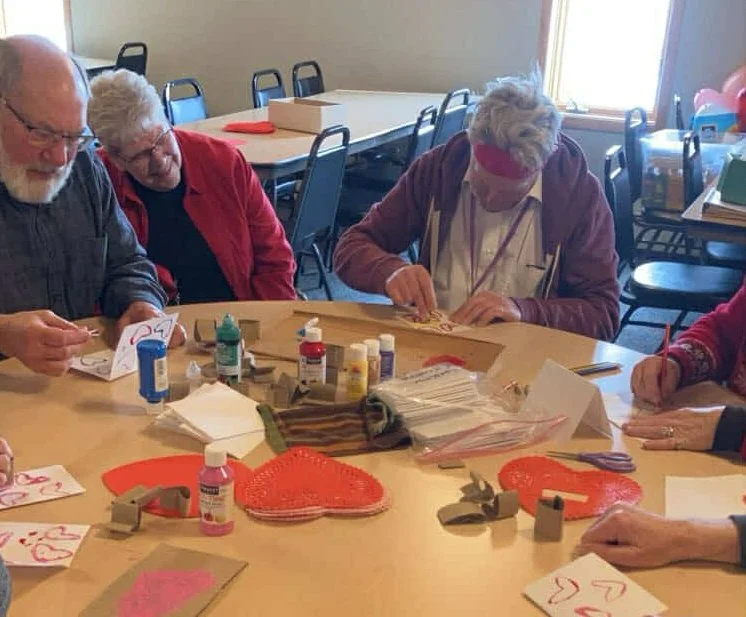
Making Valentine Day cards at A Time For Joy.
A Time for Joy
Nine of us gather at a round table. Black spongy tiles with phrases printed in white are heaped in the middle of the table. Some of us are drinking tea, most coffee. The cherry-filled fry pies are a hit! I’m one of many volunteers at A Time for Joy, an adult respite program.
Respite gives the caretakers of people living with dementia time to do their shopping, sit in the sun, read a book, or go to lunch with friends. Meanwhile, their loved one is safe and interacting with others, enjoying music and singing, a healthy home-cooked lunch, and plenty of games. Elderly folks who are isolated or lonely can also participate. Today I’ll be leading an exercise segment before lunch.
The conversation centers around baking pies, whose turn it is, and the incomplete sayings on the tiles: “is never done,” “Every cloud has,” “on the other side.” The objective is to find the matches and complete the sayings. When it’s Bill’s turn, Meg, knowing he has a match, encourages him to read his tiles. With help, he picks up the tile “is never done” and places it next to “A woman’s work.”
I remember helping my sister, Jill, play bingo at the Waterford memory care center. Jill didn’t understand how the game worked. She pressed her fingers onto the numbers being called and would try to eat the corn instead of using it as a marker.
A Time for Joy is offered every Wednesday from 10 a.m. to 2 p.m. at Immanuel Lutheran Church. Savannah Frei, the program director, greeted me warmly when I walked in this morning and joined the folks who were already sitting at the table playing the word game.
Watching Meg work with Bill, I can see how this enrichment program would have benefited Jill before she became too sick. It would have been a lifeline for her partner, Jim, and her daughter, Sam, both of whom were worn out from caretaking.
If trends follow national projections from the Alzheimer’s Association, the number of people with this disease will double over the next 30 years. By 2050, that number could rise to 13 million.
Today Savannah has hidden a golden egg, and whoever finds it will win a prize. We abandon the word game to search for the egg. “Are you sure it’s in this room?” “Maybe it’s up near the ceiling fans.” “Is it in a basket with other eggs?” It’s hard to distinguish the volunteers from the participants as everyone works together to find the egg. When we tire of looking, Savannah tells us the egg is out in the open and that she can see it—but we still can’t!
Last week at my brother’s memory care home in Oconomowoc, Jack wouldn’t even talk to the people involved in games. He only wanted me to get him out of there. A Time for Joy is best suited for people with mild dementia-related disease and those who would benefit from social interactions. Jack’s advanced disease means he’s not a candidate for this kind of program.
Tom helps Peggy place her tile, “The grass is always greener,” next to “on the other side,” as we nod and grin. Then it’s time for exercise. We start by creating a soft rain noise with our feet, eventually leading into a pounding thunderstorm as we stomp and clap. Next, pretending we have dish rags, we wipe the table with both hands, circling them from side to side, laughing as we tap our neighbor's hand, and giving ourselves a robust upper body workout.
When we return to the game, Janet helps Owen place “Every Cloud” in front of the tile “has a silver lining.” A Time for Joy is exactly that: a silver lining in a cloudy situation.
Whether exercising or playing games, there’s no rushing at A Time for Joy. We pause as someone tells a story about tobacco work back in the day or shares the recipe for their pie that took first place at the fair.
Claire, another volunteer, tells me about Jerry, who attended for the first time last week and never said a word. Yet, when his family member came to pick him up, he said cheerfully, “Today was a good day.” Claire smiles and sighs as she places her hands over her heart.
As a volunteer and someone who lost her sister to Alzheimer’s and is losing her brother, my heart fills, grateful that our community offers this program for people with dementia and their caregivers.
Driving home, I wonder who found the golden egg.

Local musicians volunteering their time and talents at A Time For Joy.
(For more information about A Time for Joy, contact Savannah Frei at 608-636-3983.)
I Believe!

I Believe
From a prone position, I tuck my knees into my chest and roll myself upright. “I believe. I believe. I believe,” I murmur as I take in the light from overhead, the cacophony of grunts, heehaws, and quacks from the yard, and note the position of the dogs.
Ruben is crawling across the king-sized bed to me, which means it’s late. He only comes upstairs if there’s a storm or I’m in bed past 6:30 a.m. Finn, who was pressed up tightly against my side moments before I woke, is now on his back, four paws in the air and spotted pink belly exposed, waiting for his morning belly rubs. But Téte is the reason we’re all awake. Her stomach tells her it’s time to eat, and she informs us with moans and sighs that will soon turn into loud, yippy barks. Meanwhile, the donkeys are braying, and if I look up, the skylight also tells me I’ve slept in. It’s 7 a.m.
I’ve gotten into the habit of saying “I believe” three times every morning, since I committed to rereading my tattered, marked-up copies of Norman Vincent Peale’s books. He suggests saying these words upon waking and throughout the day as a mantra, although I can’t remember why—or, at the moment, what I believe in.
It’s been a month when things seem cattywampus. Most days, I feel like I’ve been treading in the deep end, with water in both ears and up my nose.
This sinking feeling started before the first blade of grass turned green, when I began hobbling to get up hills. My left hip, again, seemed to rebel against even taking a step. Yet I had been skipping through the woods and around the ponds only days before.
“I believe, I believe, I believe,” started with me visualizing my left hip happy and well-adjusted in my body, where five years ago it was replaced—for the second time.
Then, coming across my journal entry, “Here Is What I Know at This Moment,” from March 2020 sent me spiraling.
I miss my mom. I mourn how my sister was before her disease. I think of Tickles and The Professor daily because the Duck Hall still stands empty.
I miss being able to fly through the woods while my ankle heals.
I worry about my granddaughter, who has CF; my brother, who has COPD; and my friends who are in health care or working essential jobs. I worry about all of you in different ways.
I worry about the world in general, but that is nothing new. I could go on, but we all could go on and on.
I try not to.
Today, I'm going to search for bloodroot, one of the first flowers to come out in spring. I'll feel grateful if I find one, and I'll search harder tomorrow if I don't.
Five years.
I’m sitting on the side of my bed now, not ready yet to stand and join the day, I keep thinking, five years… Five years seems like a lifetime ago, but also like yesterday.
March 2020 was COVID time. Life was unpredictable. My mom had just died, and less than a month after I’d written that journal entry, my sister Jill died.
My brother, Jack, is now in memory care, as Jill was five years ago. Helena has joined Mom and Jill somewhere where I hope I can someday see them all again.
Five years! Facebook has just sent me a five-year-old memory of Helena sitting with her good-natured cat, Stewart, on her lap, dancing while the family cheered them on.
I’m stuck on this five-year mark as I slump on the edge of the bed, having overslept because I didn’t sleep well. Shaking my head, I try thinking optimistically.
My ankle has healed. I can hear the Duck Hall noises when Téte gives it a rest. They speak of healthy ducks and geese. Five years ago, it sat empty after my beloved flock was massacred by a raccoon. When I feel more motivated, I’ll collect the new flock’s eggs.
But despite trying to be optimistic, I’m more worried than ever about my family, friends, and the world.
Taking that last push up and off the bed, I repeat, “I believe, I believe, I believe,” then gather my book and glasses and head down the stairs. Téte, more than ready, leads the way, Ruben follows, and Finnegan and I bring up the rear.
What I know at this moment is that once the animals are fed and my morning class is over, I’ll go with Dane and the pups to the woods and search for bloodroot. We’ve yet to see one this spring. If we don’t find any, we’ll search even harder tomorrow.

Eagles!
Eagles!
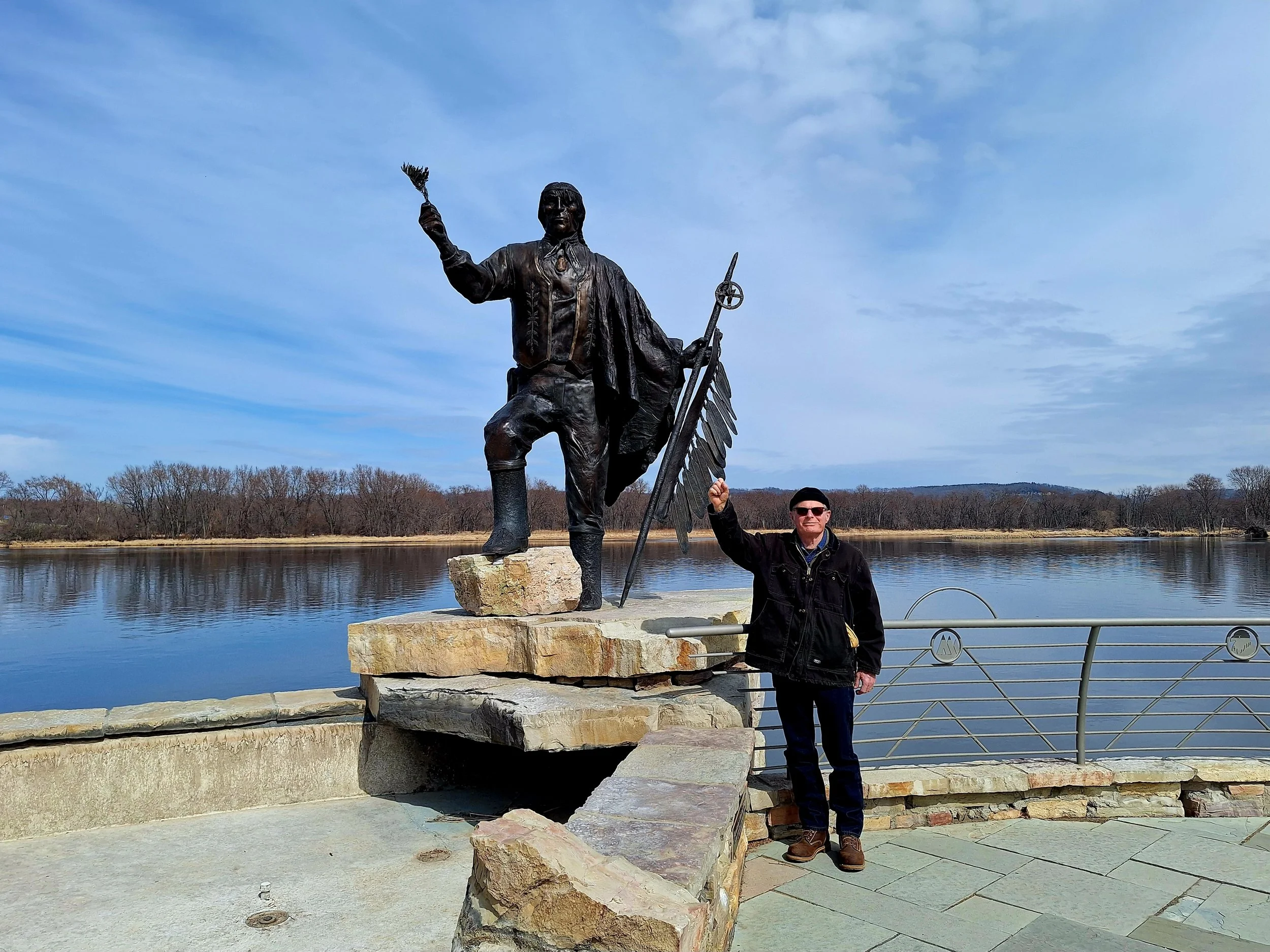
Dane is driving along Highway 61 on this gorgeous springlike morning. The sunshine makes me sleepy, But I’m fighting to keep my eyes open, not only because the view of the Mississippi River is stunning but also because we’re counting eagles. We’ve already seen seven.
Suddenly, Dane taps the brake. My eyes pop open. We’re in a cloud of juveniles!
“Eight, nine, ten!” I shout while Dane adds eleven, twelve, and thirteen. We both yell, “Fourteen!” Seven juvenile eagles, which were feeding on something nearby, were swarming in front of and around our car.
We’re going to the National Eagle Center in Wabasha, Minnesota, for their weekend festival, Soar with the Eagles. It will be our first visit to the Center.
After purchasing our tickets, we headed to the room called Ambassador Avenue. A man in a bright blue shirt answered questions and shared interesting facts with about fifteen people of all ages. Two bald eagles were perched close by.
As we inch our way to the front of the room, one of the eagles, Latsch, is hopping around frantically, flapping his wings. His foot is tethered to a chain. While I’m feeling sorry for the bird, Conor, the avian education specialist, shares that Latsch is still in training.
Latsch was spotted sitting on the ground below a nest in 2016 by a cruise ship captain. The following day the bird was still there, so the captain called the US Fish and Wildlife Service. It was discovered that Latsch (named after John A. Latsch, a conservationist who donated land along the Mississippi) was blind in his left eye.
Unable to survive in the wild, Latsch became an ambassador for the center in 2018. Today, at eight, he still overshoots his perch, flaps around a bit, then tries again and makes a perfect landing while the crowd cheers softly. He’s still in training.
Conor entertains us in a lively, theatrical give-and-take with the audience. We learn that Was’aka (19 years old), also male and noticeably smaller than Latsch, comes from Florida. He had a tumor over his left eye, making him unable to find food. Once the cancer was removed, he lost his eyesight and, like Latsch, was unable to live in the wild.
Was’aka means strength in Dakota, and although Was’aka is small at six pounds, he has a mighty presence. The size difference is related to the climate in which they were born. Latsch, a true Minnesotan, has a more substantial body due to the colder climate, and Was’aka is smaller because of the Florida heat.
Conor goes on to tell the crowd that eagles are bullies. They often wait for a gull to catch a fish, then fly in and steal it. Surprisingly, he also says they’re lazy! Eagles spend about 70 percent of their day sitting in a tree. Conor describes how they conserve their energy, don’t sweat (they pant and spread their wings in a Batman-like pose to cool off), and can soar at 30 mph or dive at 100 mph. But they don’t swim; they skim the water, snatch their prey, and then use their wings as oars to return to the shore.
By now, I’m hanging over the rail, wholly enthralled at having my questions answered so enthusiastically, while Dane is delightedly watching Was’aka tear into an enrichment toy that houses a treat.
Latsch doesn’t rip open his toy but keeps his good eye on Was’aka instead. Conor tells us that Latsch hopes to let Was’aka do the work and then steal his fish. Bullies indeed!
We’re shocked to see that over an hour has gone by, and we’ve yet to see the rest of the Center. Another program is offered at 1 p.m., so we pull ourselves away from Latsch, Was’aka, and Conor.
The next program is packed with hundreds of eagle lovers. We’re treated to a presentation by a group of powwow dancers featuring colorful costumes and intricate footwork, after which I participate in a friendship dance where we hold hands and form an enormous circle.
But what stands out the most to Dane and me is the military presentation. The Coast Guard, Navy, Air Force, Army, and Marines are all featured. As each representative carrying a flag is introduced, that military branch's flag is unfurled for us to view. Each flag features the image of a bald eagle!
On our way home, Dane comments on how we see eagles as representing bravery, strength, and freedom, yet we’ve discovered they’re actually bullies and quite lazy! Still, we agree that eagles are truly majestic birds.
Sitting as straight as the car seat will allow to spot eagles, I point and yell, “Thirty-seven, thirty-eight, thirty-nine! Three more eagles are resting in a tree before we cross the river into Wisconsin.

Flying High
Flying High
“If you’re looking for Mike, he’s outside putting duct tape on a broken wing.”
Har-dee-har, I think, as I try to steer Emily toward the door that leads to the tarmac.
Not to be outdone, another man speaks up: “Mike just got back from the bar. He’s waiting for you.”
Emily laughs, and we banter with the four men sitting at a round table in the Viroqua Airport lounge. A large off-white golden doodle lying under the table looks just as comfortable as the men do as if they’re all part of the furniture. Later, I learn from Mike Olson, director of airport operations, that these gentlemen, all pilots, have been enjoying this late-afternoon coffee gathering since the COVID-19 pandemic.
Emily and I often go on adventure dates, and this time, I thought flying would be fun. The last time I went, Carol came along, and the time before that, Dane and I took his mom. Both flights were with Roy (now Sheriff) Torgerson.
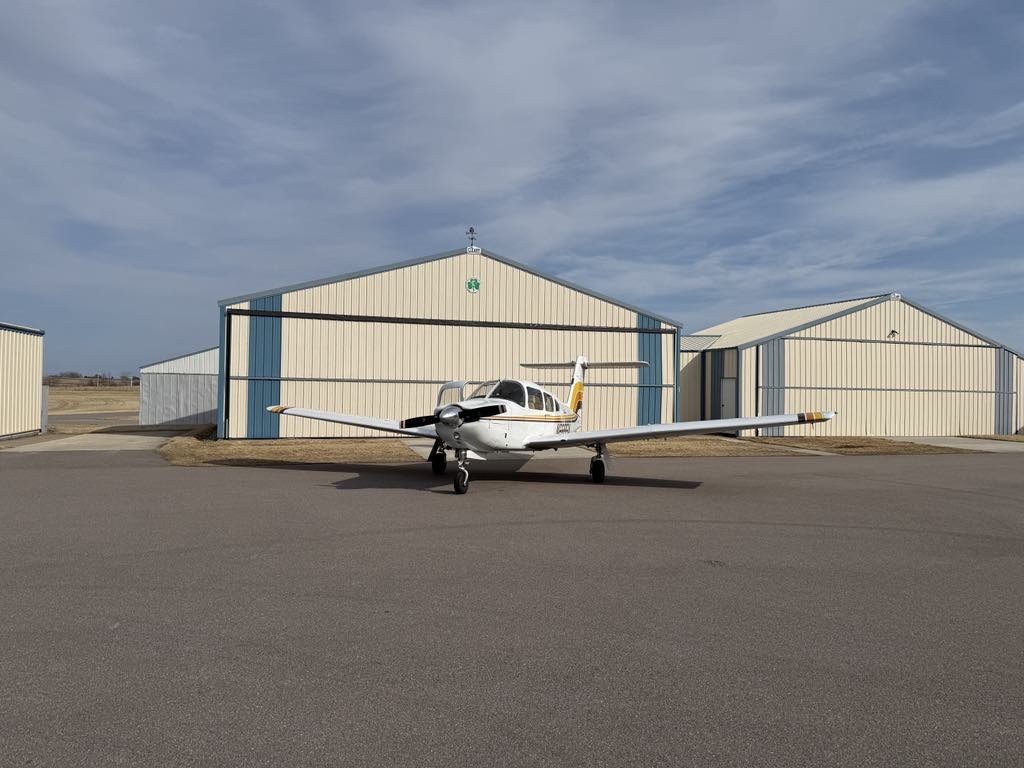
Today, we’re taking off in Mike Sebion’s Piper Arrow T-Tail, a sleek plane with velvety gold upholstery. It’s a perfect day with little wind. I’m sitting in the co-pilot's seat, and Emily is in the back. While Mike does his pre-flight preparations, I double-check that my door is closed. Before you know it, Mike’s making an announcement over the common traffic frequency, and we’re heading down the runway. We fly at an altitude of 3,000 feet, approximately 1,500 feet above the ground.
Mike and Emily are oriented immediately as they both spot Highway 82, but it takes me longer to get my bearings. I sit as straight as I can, peering out the windshield and to the side, over the wing.
Mike recently retired from dairy farming, and as he flies the plane hands-free, I ask him if he was sad to see his cows go. “Not in the least,” he deadpans, but mentions that others in his family were. Mike’s wife shares his love of flying. He even takes his 94-year-old mom flying each year!
Mike and Emily spot the copper-colored roof of my house before I do. We circle my place a few times, trying to get a good photo before we head over to the Mississippi River. I’m reminded of how low in the valley I live when seeing it from above.
Later, Mr. Olson shares with me some of the history of the Viroqua Airport, which was developed in the 1950s; he’s been involved with it in various capacities for the past 40 years. In 1990, he and other local pilots volunteered their time to help construct the terminal building. He tells me that Erin Brueggen, a corporate pilot who lives in Cashton, took all the photos that hang on the walls there. “She was in one plane, hanging out, taking pictures of those other planes,” he chuckles.
For a small town, this airport is busy, with about 2,500 flights per year. Mr. Olson tells me all 23 hangars are full, and there are always inquiries. They are working with master engineers to figure out how to accommodate more.
The Driftless Café is a draw for many of the pilots who fly in and use one of the two courtesy cars. One couple flies in monthly from southeast Wisconsin because they love shopping at the Viroqua Food Co-op. Other people fly in for the region’s outstanding trout fishing. And every July, the airport hosts the annual Fly-In Breakfast, which, despite less-than-ideal weather, served 1,000 meals last year.
Mr. Olson reminds me that the airport is public and includes a great area for family picnics, as well as the terminal, which is always open and has an observation deck. This city-owned airport receives support from the state and the FAA’s Airport and Airway Trust Fund, established in 1970, which is funded by taxes on airline tickets, air freight, and aviation fuel.
As Mike brings us in for a landing, he tells us what he’s looking at and how he’s preparing. Watching him, I’m impressed by how many controls and dials there are to learn.
Emily exclaims over the seamless landing, and we both thank Mike for giving us such a pleasant flight. One can easily see why people fly in this area. The perspective of our region's hills, valleys, winding roads, and rivers is breathtaking.
I’m impressed with Mr. Olson’s dedication, and I view our airport as a gem, not just “a playground for the rich,” as he puts it. Having an accessible airport for people to fly into, complete with courtesy cars available for fine dining, suburban shopping, or the best trout fishing in the area, is a real perk for our city. The coffee klatch men, both Mikes, and Sheriff Torgerson are bonuses!

Brother Jack, Sister Jill

(Jill’s wedding. Jack in the brown suit and me on the far right with Jessica (tummy!)
Brother Jack, Sister Jill
“Hi, Jack, it’s Jane, your sister.”
“You're not my sister. I was adopted.”
Crying, I apologize for not knowing this. It was my first conversation with Jack in two years, and I didn't know what to expect. But I know not to argue.
“Janie, don’t cry. Mr. Zelensy is my dad. That’s why I was kept in the basement.”
Jack describes having only McDonald's to eat. He says Dad gave him money, but he had to start working early. “I started working when I was nine and a half, Janie. Can you believe that?”
“No wonder your shoulders are so bad.”
Jack mentions his shoulders and torn bicep in each phone call that follows. He started his concrete business shortly after high school, and his body shows the abuse from a demanding career.
Today, Jack is 71. He calls me Janie, a name only my family has used. He claims that our sister, Jill, was also adopted when Dad returned from the Korean War. And he insists his name is Jake.
James, Jack's eldest son, recently informed me that Jack has been diagnosed with dementia. He will no longer be able to live alone and must move into memory care.
Jack and Jill, my older brother and sister—I can’t think of one without thinking of the other. Only nine months apart in age, they were as close as twins. They shared a love of football and each other.
Jill moved into memory care in 2019 and died in March 2020 at age 66.
Right before Jill entered the care home, when Mom was in the hospital, Jack and I talked more often than we ever had. We were both busy trying to keep Mom happy. Occasionally thereafter, I’d see Jack when I’d visit Mom to take her shopping or out for a hamburger. Afterward, I’d drive to see Jill in Waterford, where she resided in memory care. But Jack wouldn’t visit Jill. I didn’t understand. He acted as if she wasn’t there.
Although Jack and I weren’t as close as he and Jill were, I always called him on his birthday and other special occasions. Our conversations were pleasant, and he had a lot to say. But two years ago, when I called to wish him a happy birthday, he asked, “Who is this?”
“Your sister—Jane!” I thought he was kidding. Jack rambled on about his work, his trucks, and the weather.
Not two weeks later, I called after Dane’s heart attacks. Jack didn’t answer, so I left a message. I tried again, but still no answer.
A year passed, and I called Jack on his next birthday, but I got his voicemail again. Seven months later, I called to tell him my granddaughter, Helena, had been killed. Jack never called back. Angry, I stopped calling.
Now James tells me Jack started becoming forgetful two years ago. My heart sinks as James tells me about Jack, his confusion, the police, and his involuntary hospital stay. As James talks, the Catholic guilt that Mom raised us on has free rein in me.
Before James finishes, I apologize. I mentioned the unreturned calls and how angry I’d felt toward Jack. He assured me Jack hadn’t been returning anyone’s calls. I wondered if James knew I was the one initiating calls throughout the years, but did it matter? It seemed that James had heard this story before. I’m impressed with James’s patience as I badger him with questions in the days after learning about Jack’s illness.
Today, James tells me he found a place for Jack to live in Oconomowoc. His relief is evident, but so is his concern. He’s just finished washing and folding Jack’s clothes. On Monday, he’ll fix up Jack’s new room.
James recommended that I wait to visit Jack until he’s settled, so for now, I call daily. Jack still does most of the talking. I’m excited to see him soon and hope that by listening, I’ll bring him some comfort.
I’m kicking myself for assuming my brother didn’t want a relationship with me. Understandably, he was drained after Mom’s death and the responsibility of acting as her executor. Losing Jill was hard on him. Until she entered hospice, he still hadn’t visited her. Then he went almost every day the week before she died.
Now I realize he was in denial. And I know he wasn’t intentionally ignoring my calls. Jack is sick like Jill was.
I remember having to hear the “Jack and Jill” rhyme over and over again when we were kids, and people discovered my siblings’ names. Sadly now, I listen to it cycle through my mind: Jack and Jill went up the hill...
Tick Time
Tick Time
It’s a breezy 60 degrees today; the grass is turning green, and the mud is beginning to dry. Robins, red-winged blackbirds, and sandhill cranes are singing their sweet spring songs. After an early morning walk with Dane and the pups, he goes home while I wrap up in a blanket on the sunny back porch.
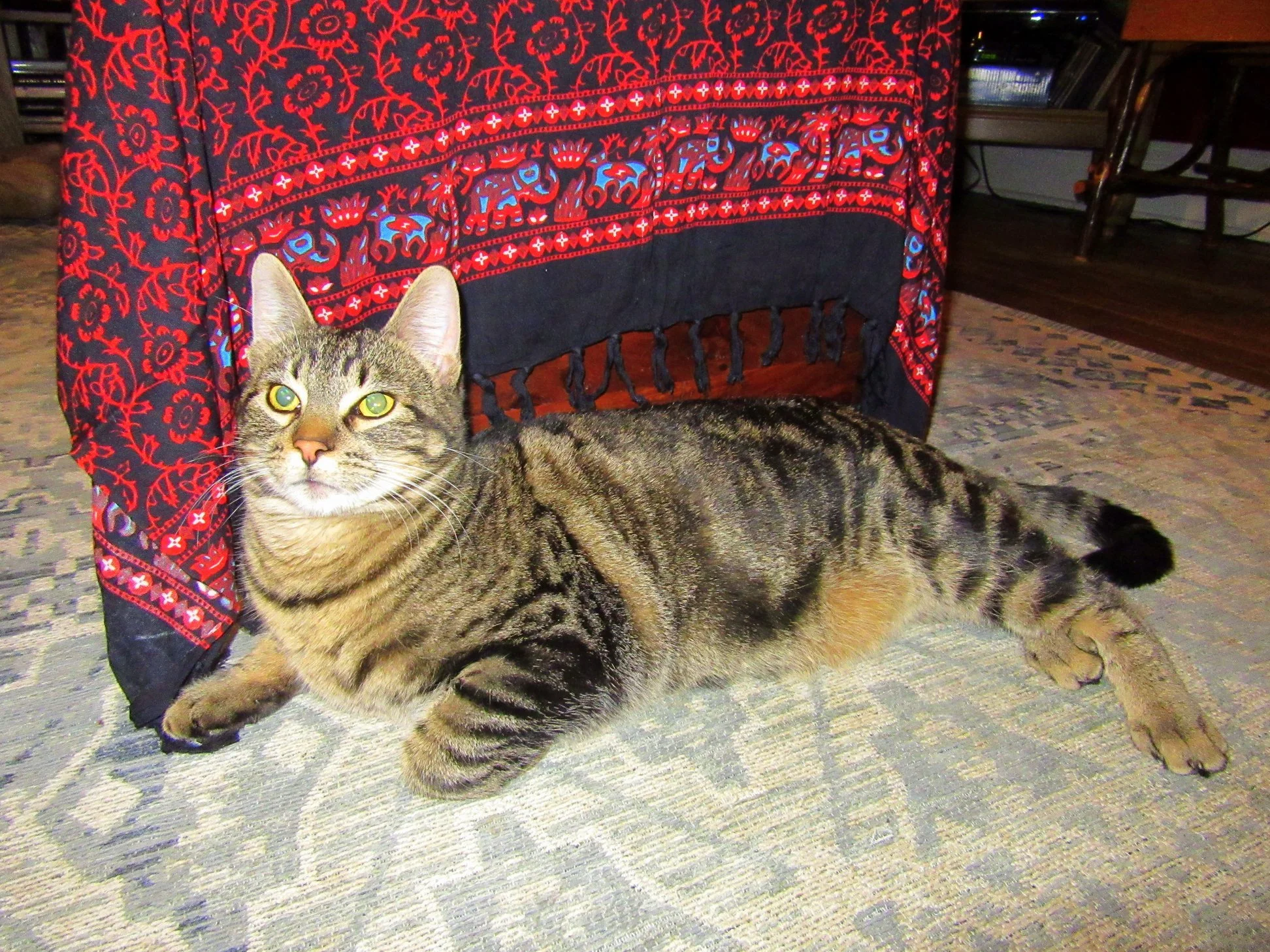
Before I can pick up my book to read, Lorca, my 25-pound cat, takes one leap and plunks down on my stomach. I start to pet him just the way he likes it: under his chin, around his ears, and on his neck.
Before I see it, I feel the swollen tick—it must have been feeding on Lorca for a few days to get to this size. You can tell how long a tick has been attached by its size and color. A deer tick will change from reddish to gray and become larger than a raisin after about six or seven days.
Learning more about ticks, which can carry and spread serious, debilitating diseases, would benefit everyone.
Here in the Vernon County area, springtime means tick time, but ticks can be out feeding anytime there is no snow covering the ground. However, most tick-borne diseases are recorded from May to July.
One in three deer ticks in our area tests positive for carrying Lyme disease or other tick-borne illnesses. Only 70 percent of people will have the telltale bull's-eye rash when bitten by a Lyme-infected tick. The rest of us must watch for flu-like symptoms and more serious effects, such as facial paralysis, fever, loss of sensation in one leg, or severe arthritis.
Recently, I learned that the best tick repellent for my animals is the kind that kills the tick when it attaches to them. If the medicine you use simply prevents the tick from attaching, you may eventually find that tick on you! Here, we use Nexgard for dogs and Frontline for cats, but other good brands exist.
This year, I learned about a product for humans made from tomatoes called BioUD. It’s a nontoxic spray that, if applied every 30 minutes, does a great job of keeping ticks at bay. The problem I had was that everywhere I looked, it was already sold out.
For the past 13 years, Dane worked for a forestry job, which supplied him with permethrin to spray his clothing. Permethrin is highly effective at killing ticks on contact. Studies have shown that people who wear treated clothing experience far fewer tick bites than people who wear untreated socks and pants.
Although Permethrin is generally regarded as safe for humans to use on their clothing, it is an insecticide, and it can be toxic. Always follow directions, don’t use it on your skin, wash your hands, and keep it away from your animals. A safe way to use permethrin is to take your boots outside, spray them, dry them, and wear them whenever you go hiking.
Hoisting Lorca off of me, I next go on a search-and-destroy mission and find other ticks that haven’t attached yet. I carefully put them in a folded napkin and take them inside the house to flush them down the toilet. Did you know ticks can live 60 days underwater?
Ticks don’t jump or fly, but they do climb. The female climbs grasses and hangs on while her front legs reach out, looking for something warm to latch on to. This is called questing. When you brush past those grasses, her claw-like hand grasps hold of you, and she then attaches and starts climbing upward. Ticks tend to like warm places—armpits, backs of knees, inside the elbow, and hairlines. But the last attached tick I had was on my upper arm.
It’s best to wear light-colored clothing while hiking. Tuck your shirt in at the waist and your pants legs into your socks. The light colors make it easier to spot the ticks, and tucking in makes it harder for them to get under your clothes.
Staying in the middle of the path is also a smart way to keep ticks at bay. When you get home, always do a tick check. It is also recommended that you throw your clothes in a hot dryer for 15 minutes.
Staying tick savvy is a never-ending job but one worth keeping up to date on. Professionals like Dr. Thomas Mather, aka the Tick Doctor, caution us that if we have cats and dogs that go inside and out, it's inevitable that we will have ticks in our house.
It’s only mid-March, and my big boy Lorca is warning me to pay attention. Lyme disease is the most common tick-borne illness in Wisconsin. Maybe you’ve had a tick-borne disease. If so, like me, you are paying attention.
Patience and Practice

“Patience, grasshopper,” is how Master Po, in the old Kung Fu TV series, would encourage his student to persevere in challenging assignments.
I’m not known for my patience. I frequently have to send a follow-up email just seconds after the first, with the subject line “Whoops,” because in my haste I forgot to attach the file or paste the link I was supposed to be including. Patience, Jane, patience, I tell myself.
“Patience, grasshopper, patience,” my friend Genie would tell me when my actions were miles ahead of my mind. At the time, I was a volunteer DJ at our local radio station, WDRT. Often, in my hurry, I’d forget to switch off the microphone after announcing what songs would be playing, and listeners could hear me start to panic when my laptop would freeze up or hear my ear-shattering yelp when someone stopped in with a zucchini as big as a canoe for my ducks.
Hearing someone scream while listening to music is not a good radio experience. Nor is having your favorite song drowned out by quacking ducklings. But I’m a person who yells out when I’m surprised, even when I see a common deer. Just ask Dane—he jumps every time. As for the ducklings, I couldn’t bear leaving them at the post office a minute longer, and my show was about to begin. I had no choice but to bring them into the booth with me.
When I worked at the West Allis Athletic Club, Jerre, the office manager, would stretch up to her full height, towering over me as she demanded that I slow down. Ninety-nine times out of a hundred, a poster I had rushed to create would have a typo. Like the one advertising my friend Al White, an amazing keyboardist and singer, who would be performing in the Courtside Cafe that Friday. My poster said, “All White,” which I argued was close. But Jerre got the last word, reminding me harshly, “Al is African American, Jane!”
Keith, my old boss at the athletic club, would remind me to be patient and slow down almost every workday during my nearly 15 years there. I often mixed up my words in my rush to communicate, creating what he called “Janeisms.” I believe he kept track of my errors to use as entertainment for his dinner parties. After all, he was a former English teacher.
Keith’s office was downstairs, and mine was upstairs near the front desk, where members would check in. One day a member said there was a car in the parking lot with its lights on; he handed me a scrap of paper with the license plate number on it.
Not wanting to waste any daylight or let the member's battery wear down, I quickly grabbed the intercom, switched it on, and in my best professional and caring voice announced, “Would the owner of the car with the license plate ‘See Me For Head’ please come to the front desk. See Me For Head.”
As Keith came bounding up the steps two at a time, Gary, the front desk manager, explained that CME4-HD was Hal’s black Porsche and that the plate should be read as “See Me for Harley Davidson.” Hal, a hard-core handball player and a regular at the club, owned Hal’s Harley Davidson in New Berlin.
Loma, my talented editor, knows my impatience well. “Patience, grasshopper,” she pleads when I pester her about the edits she’s hard at work on—especially when I interrupt her with emails asking, “Are you still working on it?” I can almost hear her scream as she rips out her hair in frustration.
Patience, Jane, patience, I’ve reminded myself through the past 13 years of writing a weekly newspaper column. Dane, Tamara, Loma, and many others encourage me to take my time, rewrite, and read out loud—but the 8 p.m. Sunday deadline always comes quicker than I expect.
I’m the first to admit I need to work on my patience. I’d also be the first person to encourage anyone out there who’s short on patience not to give up. It’s better to laugh at our mistakes, learn from them, and keep on practicing whatever we’re passionate about.
After all, it’s the practice, more than the patience, that helps us reach our dreams.
Give A Hoot

Reptile Garden, South Dakota
Give A Hoot
Smokey Bear said, “Only you can prevent forest fires.” Dad and I visited Smokey yearly at the Wisconsin State Fair, so that saying stuck with me. Smokey towered over me as he offered a coloring book about how to prevent fires. His size was frightening. I was scared into never starting a fire. It seemed that Dad should have gotten a coloring book, too.
Dad started our house on fire in 1965 while trying to burn down a wasp’s nest. He put out the flames with a fire extinguisher, but the discolored burn scar stayed. Before that, just about every Fourth of July, Dad would burn a fingertip with a firecracker or almost send Mom’s beloved hammock up in flames with a wayward bottle rocket.
The Hamm’s beer commercial jingle was also ingrained in me: “From the land of sky-blue water...” As a six-year-old, my love affair with the outdoors began with the scene of flowing water on the electric Hamm’s sign at Krahn’s Bar, where Dad often took me on Sundays. He’d watch the Packers on TV while I played with billiard balls. Eventually, I’d get sick on kiddie cocktails, potato chips, and cigarette smoke. But the images of the river and the bear left me with a longing that I couldn’t fully identify until I was an adult, backpack on my back, in the middle of nowhere. Later, Dad took us out west on a family vacation that cemented my love for nature.

Isle Royale trip
As a teenager, I was impressed by an ad that showed a Native American weeping when trash thrown from a passing car landed at his feet. Created by an ad agency for Keep America Beautiful, it first aired on Earth Day in 1971 and won two Clio awards. Seeing a grown man’s tears left me with a deep sadness.
Understandably, the ad was eventually criticized for stereotyping Indigenous culture and was retired in 2023. But it had served a purpose: It helped reduce litter by 88 percent across 38 states. I know that ad impacted me. I never wanted to make anyone cry. And if any of us Schmidt kids tried tossing something out our station wagon window, Dad’s booming voice would also leave an impact.
“Give a hoot, don’t pollute,” was another slogan that shaped my attitude. With his huge yellow eyes, Woodsy the Owl was part of a US Forest Service campaign.
I think of these sayings on a sunny, warm February day in Wisconsin. This winter brought hardly any snow and barely a week’s worth of below-zero weather. Global warming is worsening, with 2023 and 2024 tied for the warmest years on record. Scientists say that American lives are more at risk with the recent firing of thousands of employees at the EPA, NOAA, and the Departments of the Interior and Energy.

Making snowballs out west in the summert
I’m trying to wrap my mind around the political nightmare we’re living in. “Only you can prevent forest fires...” leads me to think, “Only we can prevent a national disaster.” But 51 percent of us who cared enough to vote were bamboozled by lies about Christianity and grocery prices.
Now what?
“Give a hoot...” I do, I do! But the campaign chant of “Drill, baby drill” pierces my peace. Will the mountains we saw out west be destroyed? If so, what about the elk and antelope? Where will they go?
My mind drifts back to the lessons learned from effective ad campaigns when I was an impressionable child. I’m careful with fire, although admittedly, I’ve started two: one at the cabin on Pa’s Road (no harm done) and another here, when I thought the bucket of ash I dumped had cooled. The first fire truck to arrive put out this fire, but to my embarrassment, more trucks kept racing down my road with their sirens and lights on.
What would Dad do, say, and think if he were alive now? When people were celebrating Smokey Bear’s 80th birthday last year at the fairground, Dad would have been 97 years old. Because Dad was a man of integrity who served his country for 34 years, he never would have voted for our current president. Would he be protesting, writing letters, making phone calls—and would that be enough?
Memories make me nostalgic in these challenging times. After my first trip down the Grand Canyon, I thought about becoming a ranger. In the evening they’d visit each campsite and also hold weekly talks. Their passion for keeping America beautiful and us safe was admirable. In the past month, 3,400 Forest Service employees have been fired, including those qualified to fight forest fires.
Today, with the sunlight streaming in, I feel like Iron Eyes Cody in that long-ago ad as tears run down my face.