Frank’s Hill
Dane struggled to recall his last visit to Frank’s Hill—until he remembered the thorns.
“Thorns?” I asked.
“Yes, they’re sitting upstairs on my dresser.”
As we pulled over on Highway 193 after the intersection with Highway 60, outside of Richland Center, I suddenly remembered.
“Oh, the thorns that look like they came from Jesus’s crown?”
“Yep.”
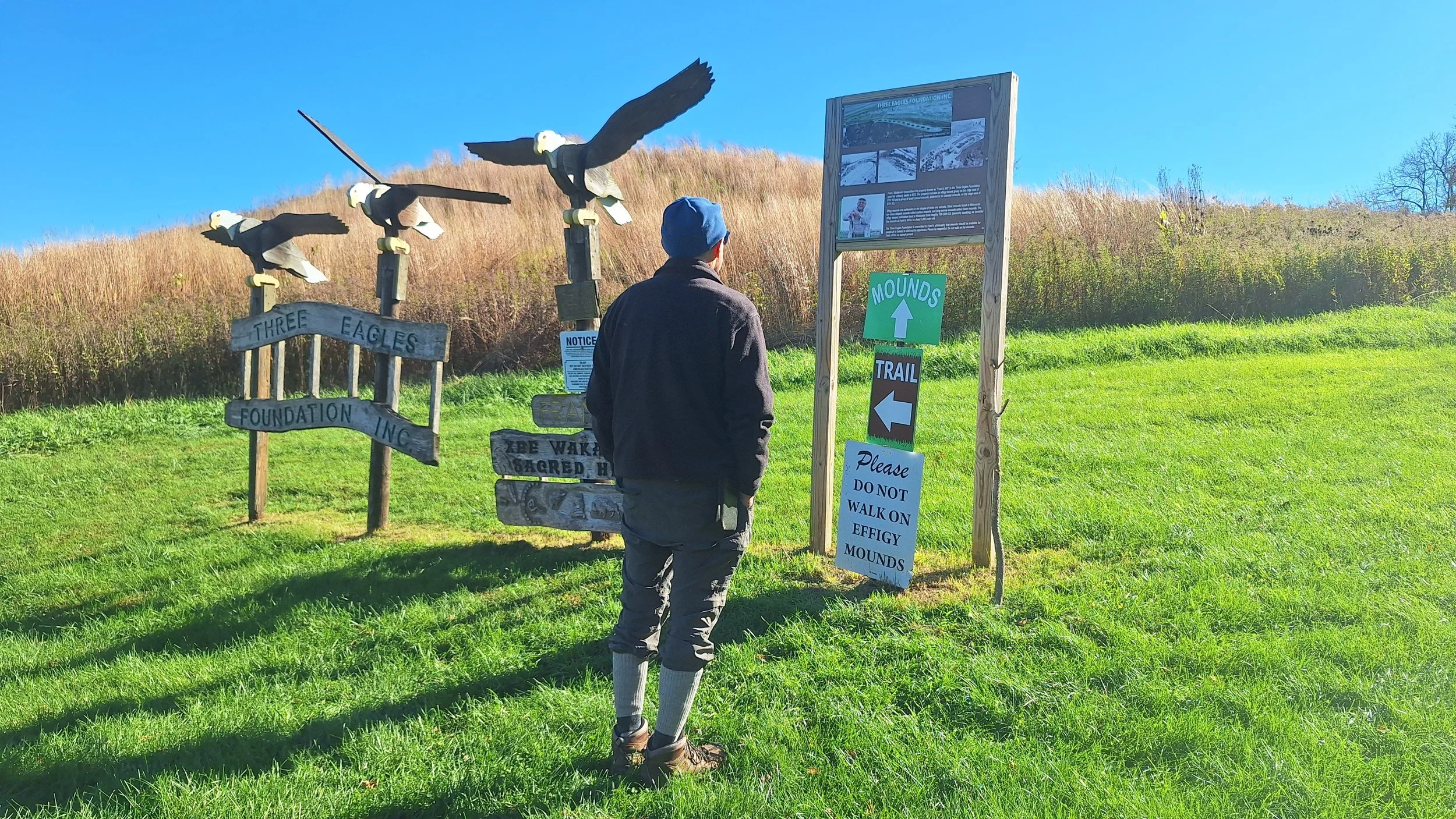
The first thing you’ll notice after parking at Frank’s Hill, as you scoot past the gate that keeps cars out, is a totem pole on the right side of the path. Further up and to the left, three wooden poles topped with eagles stand next to a sign that reads “Three Eagles Foundation.” A picture and biography of Frank Shadewald, who gifted the land to the Foundation upon his death, is also displayed.
The property includes effigy mounds on the east ridge and small conical mounds, thought to be calendar markers, across the highway on the west ridge. The mounds on Frank’s Hill (known as Xee Waka Cak, meaning “Sacred Hills”) are considered to be 1,000 years old. At this time of year, I often visit the hills, sometimes with my youngest dog Ruben, my girlfriends, or Dane.
Dane stops to read the sign and reconnect with Frank, who wanted the mounds to be open to people of all beliefs to visit and experience. I find that the hills, especially the east ridge with the effigy mounds, promote a sense of peace when I walk them slowly, stopping often to take in the vastness of the surrounding area.
Wild native grasses cover the mounds, making their shapes hard to discern. Every spring the caretakers do a prescribed burn, and I’d like to visit the hills then. I wonder if I could make out the shapes: a coyote, bison, beaver, bird woman (or, some say, corn woman), and a coiled snake. In images I’ve seen of the hill taken from above in winter, the shapes are clearly visible.
Effigy mounds are sacred ancestral landmarks built by prehistoric Native Americans in the shapes of animals, birds, humans, or symbols. Most sites are in the Upper Midwest, especially in Wisconsin, but also in Iowa and Minnesota. Some effigy mounds are said to contain human remains and artifacts, while others, like the conical mounds, served as ceremonial, territorial, or calendar markers to mark planting seasons.
Once you walk up the ridge on the mowed grass path, you can follow the trail around the different mounds, sit on any number of benches to look over the countryside, and discover the area where folks gather on winter solstice evenings to remember the events of the past year, contemplate the new year, and learn more about Frank’s Hill. I tell Dane we must remember to come back this December. One of the benches near the fire pit has the word Resilience carved in it, possibly someone’s New Year intention.
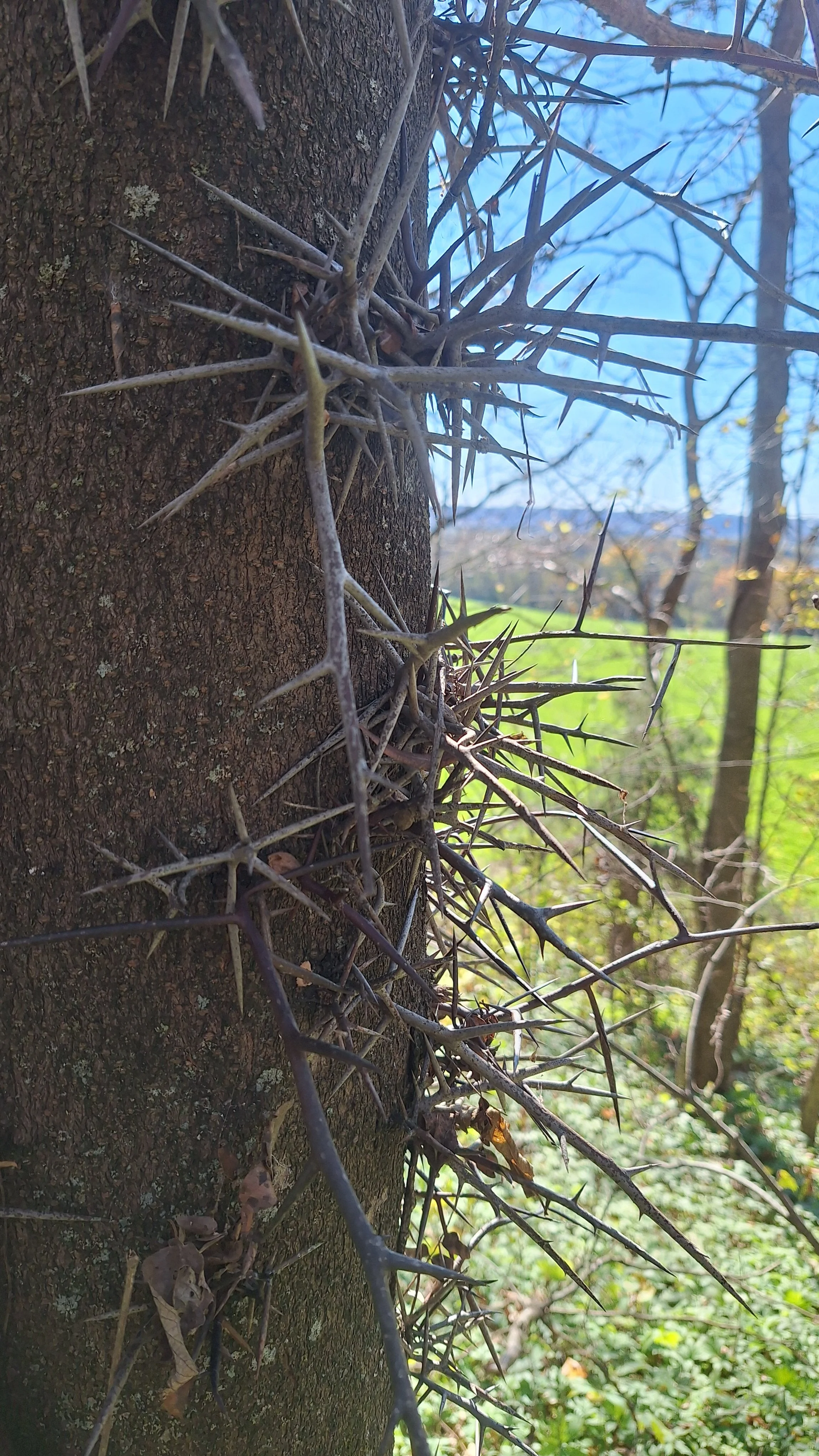
Continuing on the trail past the fire pit, Dane looks up and spies the honey locust tree where he got his thorns on his last visit. The thorns are long and sharp, and they look like the ones I’ve seen in depictions of Jesus’s crown. They grow on the trunk and branches and can be up to 8 inches long, so I’m extra careful when I take close-up pictures. A little further along, we see a few more honey locust trees, their pods scattered on the ground along with an abundance of leaves.
The trail is steep, and as we wind our way down, we get glimpses of the Pine River below. I’m careful not to trip on hidden roots and rocks. Dane steps over downed trees easily, while I sit sideways on them and then hike my legs over, one at a time. Ticks are plentiful this time of year, so we’re both wearing Insect Shield socks, and our pants have been treated with permethrin.
After a mile, the trail brings us right back to where we parked.
The 10-minute drive south from Richland Center on Highway 80 is worth it. Turn west (right) on Highway 60, go about 2 miles, turn right on Highway 193, and you’re there. Watch for the gates and the mowed area—it’s easy to miss. The mounds line both sides of the road, but you’ll need to get back in your car and drive a little farther before you see the west-side entrance.
When I visit, it’s easy to imagine Frank’s Hill as a site of great ritual ceremonies. The Foundation asks that we stay off the mounds and treat the area with respect.